The collapse of Assad’s regime in Syria isn’t just another international headline. For those living in societies that depend, directly or indirectly, on imperial or colonial arrangements, it’s a reminder that entrenched power is not invulnerable. When we see officials dragged from their offices and once-untouchable authorities fleeing, we recognize that if carefully maintained hierarchies can crumble there, they might crumble anywhere. This recognition often stirs a nervous unease among so-called allies - people who claim to support liberation but prefer it safely limited to symbolic or distant acts rather than meaningful transformations.
The shifting lens of Western media plays a key role in nurturing this unease. Early reporting on uprisings frequently frames them as heroic struggles for justice, human rights, and democracy. But as soon as the movements start to redistribute power in disruptive ways, dismantling oppressive structures and redrawing the boundaries of political and economic control, these same outlets often change their tune.
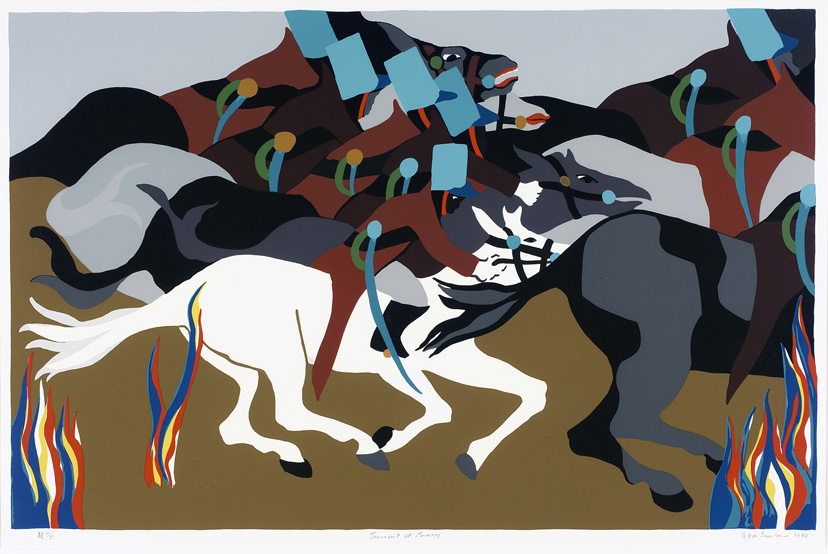
Toussaint at Ennery by Jacob Lawrence (1989)
To understand today’s reactions, it helps to begin with one of the most profound challenges to the imperial order: the Haitian Revolution (1791–1804). As C.L.R. James meticulously details in The Black Jacobins, the formerly enslaved people of Saint-Domingue overthrew their French colonial rulers and declared independence, founding the world’s first Black republic. Initially, many European and North American observers expressed cautious respect, at least in principle. After all, Enlightenment ideals championed liberty and equality. But once it became clear that Haiti’s revolutionaries weren’t just asking for freedom - they were seizing it and restructuring power entirely - outside sympathy curdled into fear and condemnation. Historians like Laurent Dubois have shown how newspapers and pamphlets of the era began depicting Haitians as unruly and dangerous once it sank in that they intended to maintain control over their own land and labor.
This pattern of initial praise followed by subsequent condemnation echoes throughout the 20th century. Consider the Algerian War of Independence (1954–1962), which Frantz Fanon examined in works like A Dying Colonialism and The Wretched of the Earth. Early on, some Western commentators acknowledged the cruelty of French colonial rule. Yet when the Algerian National Liberation Front (FLN) took up arms to end that rule, and when it became clear that they aimed not just to replicate European-style governance but to assert their own cultural and political autonomy, sympathy waned. Media coverage began fixating on the “violence” and “terror” of the FLN rather than the systematic oppression Algerians had endured under French domination. The demand for genuine sovereignty was framed as instability rather than long-overdue correction.
Similarly, in Kenya during the 1950s, the Mau Mau rebellion sought to reclaim land and rights stolen under British colonialism. While some observers in the UK initially criticized the brutality of colonial policies, British newspapers such as The Times and government propaganda quickly worked to portray Mau Mau fighters as savage threats to order, rather than people asserting a claim long denied. By focusing on the “excesses” of the rebels rather than the racist settler system that provoked the uprising, Western narratives reassured their audiences that any radical restructuring of power was inherently suspect.
The mid-20th century offers more examples: The Cuban Revolution (1959) initially attracted sympathy from Americans tired of supporting a corrupt dictator like Batista. But after Fidel Castro’s government nationalized industries and forged alliances independent of U.S. interests, U.S. media and politicians transformed the image of Cuban rebels from plucky freedom fighters into menacing radicals endangering the hemisphere’s stability. In Iran, the 1979 revolution against the Shah - an absolute monarch propped up by Western powers - was at first framed as a popular push against tyranny. Yet once the revolution produced an Islamic Republic that defied U.S. strategic interests, media coverage turned apprehensive, fixating on “fundamentalism” and “chaos” instead of acknowledging the long legacy of Western-backed repression that fueled the revolt.
By the time the Arab Spring erupted in 2010-2012, we could see a familiar script. News outlets like The Guardian and Al Jazeera English initially celebrated “people power” from Tunisia to Egypt. Commentators marveled at peaceful protests and the potential birth of new democracies. Scholars such as Lisa Anderson wrote about the Arab Spring as a sign that citizens could topple dictators without firing a shot. But when these movements didn’t produce quick, Western-style democracies - or when some factions demanded genuine economic redistribution, challenged foreign influence, or took direct action against loyalists - coverage started emphasizing instability and radicalism. The same Western publics that cheered protesters holding signs became uneasy when revolutions touched the raw nerves of global power structures.
This pattern shows up today in Indigenous struggles against settler-colonial states. The initial narrative might highlight their spiritual connection to the land, presenting us as noble defenders of nature. But if these communities block pipelines for months, reclaim resources, or assert sovereignty that threatens corporate profits and governmental authority, the story changes. Now they become “obstructionists,” their actions “illegal” and “economically harmful.” The original violence - land theft, forced assimilation, environmental degradation - is background noise. Once again, the oppressed are framed as dangerous when we truly test the system’s foundations.
So how does this history help us understand what’s happening in Syria as Assad’s regime crumbles? Already, global media outlets show mixed responses. Initially, many cheered the fall of a brutal dictator and praised the courage of those who challenged him. But as groups on the ground begin to shape a new order - one that may not align with Western interests - watch how the narrative shifts. If the revolutionaries or those who fill the vacuum challenge foreign investments, reject imposed political models, or demand full control over resources, don’t be surprised if coverage turns sharply critical. The media’s tone, as Peter Gelderloos and others have argued, often reflects what levels of autonomy and disruption are deemed acceptable by foreign powers and their publics.
This awareness doesn’t mandate blind faith in every revolutionary movement, nor does it deny that some struggles are complex and even internally fraught. The Haitian Revolution, the Algerian War, the Mau Mau uprising, the Cuban and Iranian Revolutions, and the Arab Spring were each unique, with their own contradictions and unresolved tensions. But acknowledging these patterns - where initial sympathy evaporates once the oppressed claim actual power - helps us see beyond narratives tailored for distant audiences.
For readers who want to engage openly and critically with Syria’s unfolding story, this means asking: Who benefits if we fear radical change? Which voices are privileged by media coverage, and which are sidelined or demonized? Can we identify when commentators shift from calling for liberation to warning about the perils of “excess”? Understanding the legacy of past revolutions and their portrayals can help us anticipate how global media might frame Syria’s post-Assad reality. Rather than becoming nervous allies who shrink from the tough questions, we can approach this historical moment with clarity. By seeing how often sympathy gives way to caution and condemnation, we learn to ask not “Are they too radical?” but “Who decides what ‘too radical’ means - and why?”